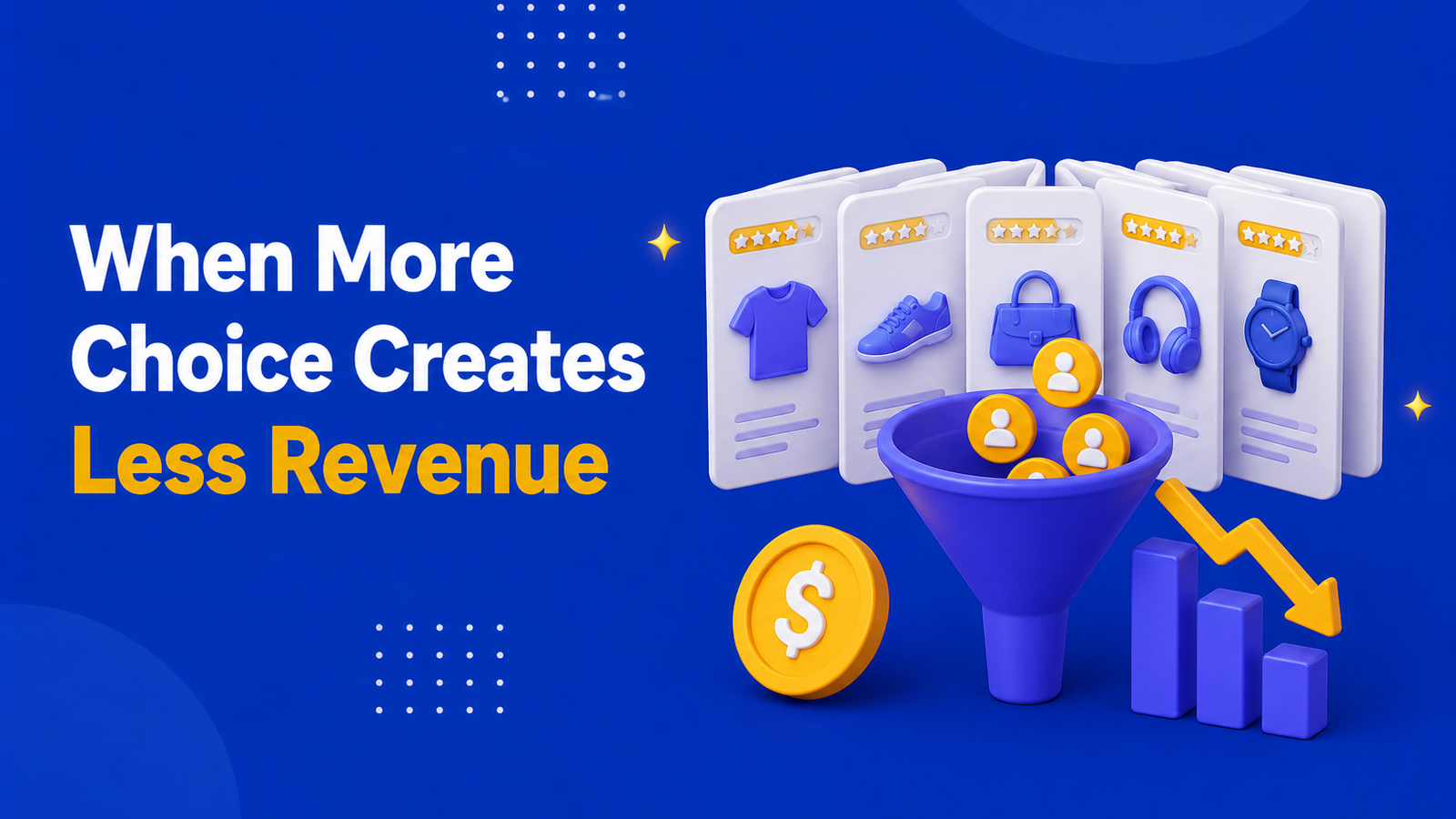
Offering users more choices often seems like an obvious way to improve engagement. A larger offerwall can provide more opportunities, a broader reward catalog can appeal to more preferences, and additional monetization options can make a product appear more flexible. From a publisher's perspective, expanding the number of choices can seem like a straightforward way to increase the number of users who find something relevant.
However, more choice does not always translate into more action. When users are presented with too many offers, rewards, or paths forward, the decision itself can become a source of friction. Instead of helping users find the right opportunity, an overcrowded experience can make it harder to decide where to begin, increasing hesitation and reducing the likelihood of conversion.
This creates an important challenge for monetization teams. The objective is not necessarily to provide the maximum number of options, but to make the right options easier to recognize and act on. Several factors explain why excessive choice can reduce engagement and, ultimately, revenue.
1. Too Many Options Can Slow Down the Decision
When users open an offerwall, they are usually trying to answer a relatively simple question: which offer is worth my time? If the interface immediately presents dozens of opportunities with different requirements, rewards, durations, and conditions, answering that question becomes more difficult.
Instead of evaluating one promising opportunity, users may begin comparing several offers against each other. They look at the reward, estimated effort, advertiser, completion requirements, and potential outcome before deciding whether to start. This additional evaluation takes attention and creates a greater opportunity for the user to leave without selecting anything. A smaller, more focused selection can sometimes create a clearer path to action than a much larger offer catalog.
More options can increase potential value while simultaneously increasing the effort required to choose.
2. Offer Quality Becomes Harder to Recognize in a Crowded Experience
A large number of offers can also make it difficult for high-quality opportunities to stand out. When every offer competes for the same visual attention, users may struggle to distinguish between offers that are genuinely relevant and those that require more effort for relatively little value.
This can reduce the effectiveness of the entire offerwall because users may judge the experience based on what they see first. If the initial selection feels repetitive, confusing, or poorly matched to their interests, they may assume that the remaining offers are unlikely to be worthwhile. The issue is therefore not simply the number of offers available, but how effectively the experience helps users identify the opportunities most relevant to them.
A crowded offerwall can make valuable opportunities harder to recognize, even when the underlying inventory is strong.
3. Choice Overload Can Reduce Offer Completion
Choice overload becomes particularly important when offers have different levels of complexity. A user might see one offer requiring a few minutes, another requiring several days of gameplay, and another requiring multiple milestones. Although having these options provides flexibility, comparing them requires users to estimate effort and potential value before making a decision.
That calculation can become even harder when reward amounts vary significantly. A larger reward may appear attractive but require substantially more effort, while a smaller reward may provide faster value. If the platform does not make these differences easy to understand, users can postpone the decision or abandon the offerwall entirely.
When choosing becomes harder than completing the offer itself, additional options can become a barrier rather than a benefit.
4. Personalization Can Turn Choice Into Relevance
The solution to excessive choice is not necessarily reducing the available offer inventory. Publishers can maintain a broad range of opportunities while presenting users with a more focused selection based on relevance, behavior, location, progression, or previous interactions.
Personalization helps shift the experience from "Here are all the offers available" to "Here are the offers most likely to interest you." This can reduce cognitive load while preserving access to a larger underlying inventory. It also gives publishers an opportunity to learn which categories, reward levels, and completion requirements resonate with different user segments.
The goal is not to remove choice. It is to organize choice in a way that makes the next decision easier.
Personalization turns a large inventory into a smaller set of opportunities that feels more relevant to each user.
5. Better Choice Architecture Can Protect Revenue
Revenue optimization is often associated with adding more monetization opportunities, but the structure through which those opportunities are presented can be just as important. Publishers need to consider how users navigate the available options, how quickly they can understand an offer, and whether the interface helps them make a confident decision.
A well-designed offerwall can prioritize relevant opportunities while still allowing users to explore the broader inventory when they want more choices. Clear categorization, sensible ranking, meaningful filtering, and personalized recommendations can make a large offer ecosystem feel manageable rather than overwhelming.
The strongest monetization experience is therefore not necessarily the one with the most choices. It is the one that makes valuable choices easier to discover, understand, and act on. When publishers focus on reducing decision friction rather than simply increasing inventory, they can create an offerwall that supports both user experience and sustainable revenue.
The strongest monetization experience is not the one with the most choices. It is the one that makes the right choice easiest to find.