Cognitive Load in Offerwalls: How Too Many Choices Reduce Conversions

Ajeet Thapa
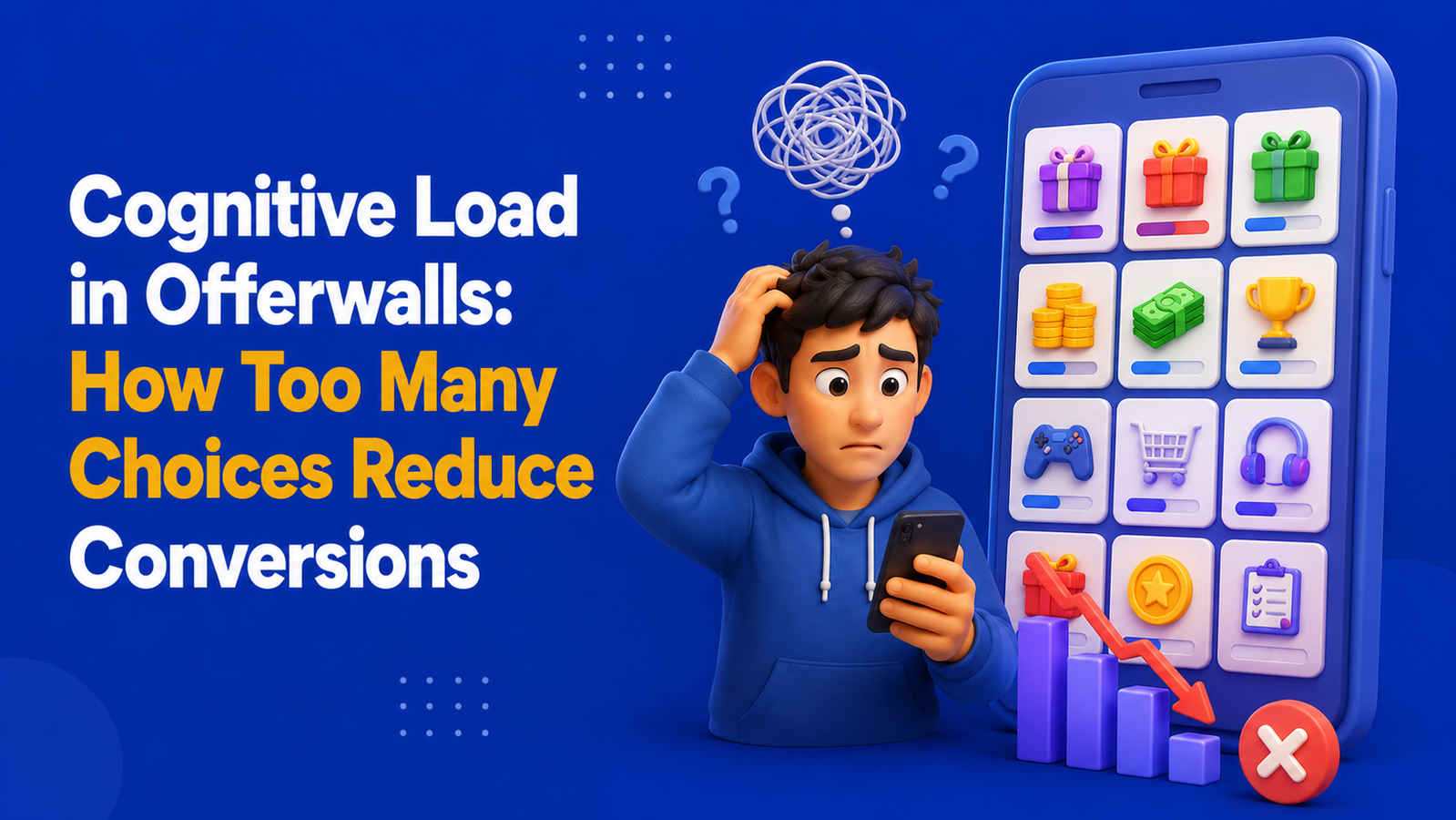
The rapid growth of offerwall platforms has transformed how apps and digital products monetize user engagement. By presenting users with a variety of tasks, offers, and rewards, offerwalls create opportunities for both users and businesses to benefit. However, as these platforms continue to expand, an important question emerges: can offering too many choices actually reduce user conversions instead of improving them?
Understanding Cognitive Load in Offerwalls

Cognitive load refers to the amount of mental effort required to process information and make decisions. In digital environments, every piece of information a user sees contributes to this load. When users open an offerwall, they are immediately faced with multiple offers, each with different rewards, requirements, and conditions.
While variety is intended to increase engagement, it also forces users to evaluate more options before making a decision. This evaluation process consumes mental energy. If the effort required becomes too high, users may feel overwhelmed and lose motivation to continue.
In offerwalls, cognitive load is often unintentionally increased through cluttered layouts, inconsistent offer formats, or unclear descriptions. Instead of guiding users toward action, the interface creates friction that slows down decision-making. As a result, users may browse without committing to any offer.
The Paradox of Choice and Decision Fatigue

Offerwalls are built on the idea that more options increase the chances of user engagement. However, the paradox of choice suggests the opposite can happen. When users are presented with too many options, decision-making becomes more difficult rather than easier.
Users may start comparing offers, trying to determine which one provides the best reward for the least effort. This comparison process can quickly lead to decision fatigue, where the user becomes mentally exhausted from evaluating too many possibilities.
As decision fatigue sets in, users tend to simplify their behavior. They may either choose nothing at all or leave the platform entirely. In many cases, users postpone their decision, intending to return later but never doing so. This directly reduces conversion rates, even when the available offers are attractive.
How Excessive Choices Reduce Conversions

Too many choices affect conversions in subtle but significant ways. First, they increase the time it takes for users to take action. In fast-paced digital environments, even small delays can lead to drop-offs.
Second, excessive options create uncertainty. When users are unsure which offer is best, they hesitate. This hesitation lowers confidence and reduces the likelihood of starting or completing an offer.
Third, similar-looking offers can dilute perceived value. If multiple offers appear almost identical, users may struggle to differentiate between them. This confusion can make offers feel less trustworthy or less appealing, further reducing engagement.
Over time, these effects compound. Instead of exploring the offerwall with interest, users begin to associate it with complexity and effort. This negative perception can impact not only immediate conversions but also long-term retention.
Simplifying the User Experience

Reducing cognitive load starts with simplifying how information is presented. A well-structured offerwall allows users to quickly understand their options without needing to analyze every detail.
Clear visual hierarchy plays an important role here. Key information such as reward value, estimated effort, and task type should be easy to identify at a glance. Consistent layouts and concise descriptions help users scan through offers efficiently.
Another effective approach is limiting the number of visible options at one time. Instead of displaying all offers simultaneously, platforms can present a curated set of options and allow users to explore more if needed. This reduces initial overwhelm while still maintaining variety.
Grouping offers into categories also helps users focus on relevant choices. When users can narrow their attention to a smaller set of options, decision-making becomes faster and more intuitive.
Balancing Variety with Usability

Offerwalls still need to provide a diverse range of opportunities to cater to different users. The goal is not to reduce options entirely, but to present them in a way that feels manageable.
Personalization is one of the most effective ways to achieve this balance. By showing users offers based on their preferences, location, or past behavior, platforms can reduce irrelevant choices and make the experience more efficient.
Prioritization also helps guide user behavior. Highlighting recommended or high-performing offers can act as a shortcut for users who are unsure where to start. This reduces the need for extensive comparison and encourages quicker decisions.
Ultimately, the most effective offerwalls are those that combine variety with clarity. Users should feel that they have enough options to choose from, but not so many that the experience becomes overwhelming.
Conclusion
Cognitive load plays a critical role in how users interact with offerwalls. While offering a wide range of choices may seem beneficial, too many options can lead to confusion, decision fatigue, and lower conversions.
By simplifying the user experience, organizing information effectively, and guiding users toward relevant offers, platforms can reduce mental effort and improve engagement. The key is to present choices in a way that aligns with how users naturally process information.
As offerwalls continue to evolve, platforms that prioritize clarity and usability will be better positioned to achieve higher conversions and long-term user satisfaction.
Related Articles

Ethics in Offerwalls: How to Keep Users Happy and Honest – Transparency and trust tips.
Ethical offerwalls build user trust and long-term engagement. Learn how transparency, clear requirements, reliable rewards, and honest communication create a better and fairer offerwall experience.

Tapjoy vs AdGem: Comparing Two Mobile Offerwall Platforms
Learn how Tapjoy and AdGem compare across offerwall integration, campaign relevance, tracking, reporting, and monetization strategy to help mobile publishers evaluate their options.

Why High-Value Offers Can Underperform: The Psychology Behind Bigger Rewards
Discover why bigger rewards do not always drive conversions and how effort, trust, complexity, and perceived value influence offerwall performance.