Why Reward Timing Matters: Instant vs Delayed Rewards in Offerwall Monetization

Ajeet Thapa
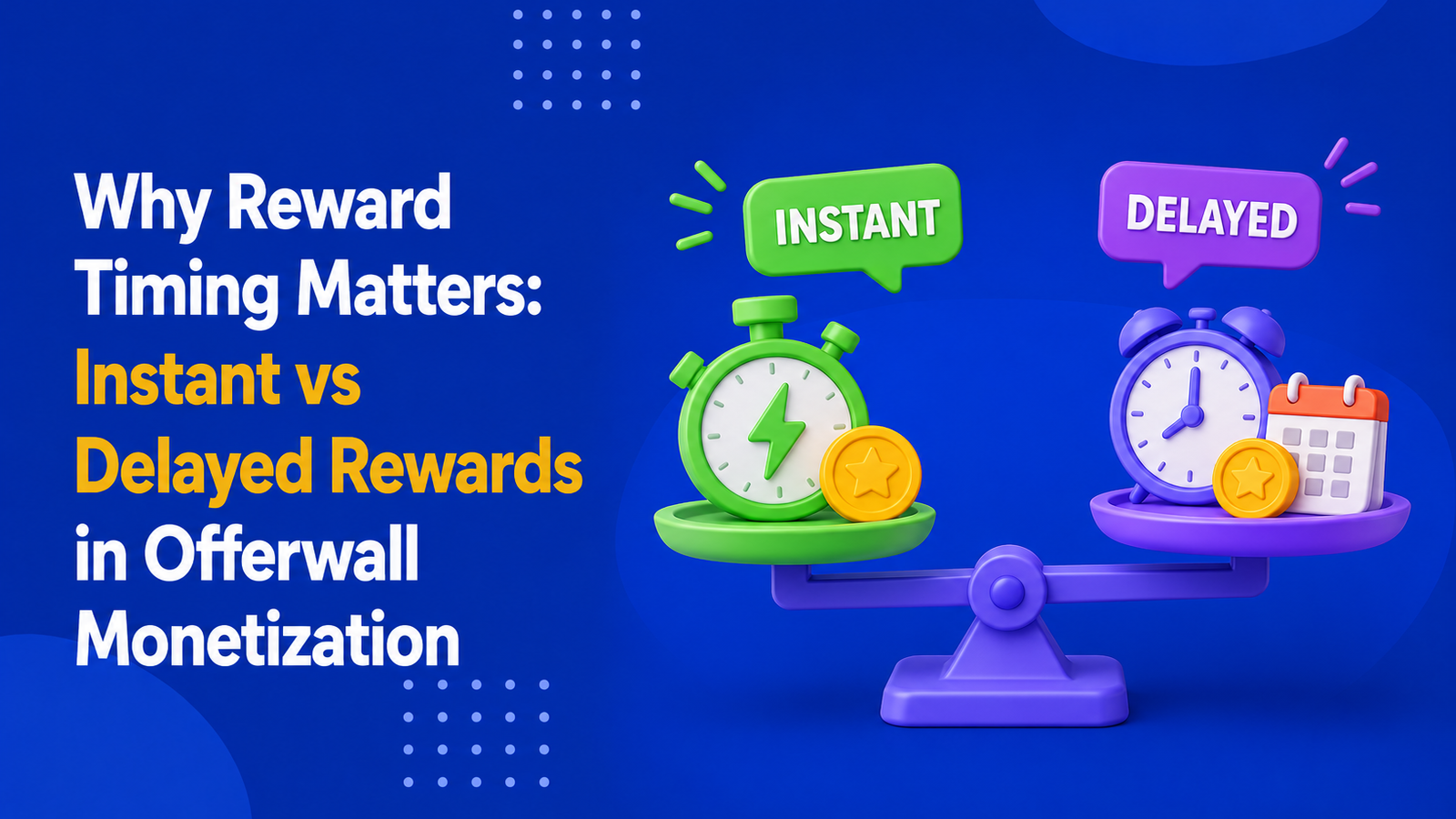
In offerwall monetization, rewards are more than just a payout. They are an essential part of the user experience, influencing how players perceive fairness, trust, and the overall value of completing an offer. Whether a user installs an app, completes a survey, signs up for a service, or reaches a required milestone, the timing of the reward can significantly shape their experience.
Choosing between instant and delayed rewards is therefore much more than an operational decision. It affects user satisfaction, offer completion rates, fraud prevention, advertiser confidence, and the long-term success of an offerwall strategy. While instant rewards can strengthen engagement and motivation, delayed rewards often play an important role in verification and maintaining ecosystem integrity. Understanding when each approach is most effective requires looking at several factors, which are discussed in the sections below.
1. Reward Timing Shapes User Trust
Trust is one of the biggest factors behind offerwall performance. When users open an offerwall, they are making a small agreement with the game. They give their time, attention, or action in exchange for virtual currency, gems, coins, lives, energy, or another in-game benefit.
If the reward appears quickly after completion, the user feels that the system works. This creates confidence and makes them more likely to return to the offerwall again. On the other hand, when a reward is delayed without explanation, the user may feel ignored, confused, or even cheated.
This is especially important for first-time offerwall users. A player who completes their first offer and receives the reward smoothly is more likely to see the offerwall as a useful part of the game. But if their first experience involves waiting, uncertainty, or contacting support, they may avoid offerwalls permanently.
Reward timing is not only about speed. It is about confidence. Users are more willing to complete future offers when they believe the reward system is transparent, predictable, and fair.
For publishers, this means reward timing should be communicated clearly. If an offer provides an instant reward, users should know it. If an offer requires verification and may take several hours or days, that should also be clearly displayed before the user starts the task.
2. Instant Rewards Create Faster Engagement
Instant rewards are powerful because they provide immediate satisfaction. In mobile games, users are often motivated by short-term goals. They may need extra coins to upgrade a character, more gems to unlock an item, or additional energy to continue playing. When an offerwall gives them a fast reward, it connects directly with their current need.
This creates a strong engagement loop. The user wants something in the game, completes an offer, receives the reward quickly, and continues playing. That smooth loop can improve session length, increase offerwall usage, and make rewarded advertising feel like a natural part of gameplay.
Instant rewards work especially well for simple and low-risk actions, such as short surveys, app launches, registrations, or basic engagement tasks where verification can happen quickly. These offers are attractive because they remove friction. The player does not need to wait, refresh, or wonder whether the task was counted.
However, instant rewards must be used carefully. If every reward is given immediately without enough validation, bad actors may exploit the system. This can lead to fake completions, low-quality users for advertisers, and revenue loss for publishers. Instant rewards are best when the tracking system is strong, the task is simple to verify, and the fraud risk is low.
3. Delayed Rewards Help Protect Advertiser Quality
Delayed rewards are often necessary when an advertiser needs to confirm that the user completed a meaningful action. For example, some offers require users to reach a certain level in another game, complete a trial period, make progress inside an app, or maintain an account for a specific time. In these cases, the reward cannot always be granted instantly because the action needs proper verification.
This delay helps protect advertisers from fake or low-intent users. It ensures that rewards are only given when the required action is truly completed. For CPA-based offerwalls, this is especially important because advertisers pay for specific outcomes, not just impressions or clicks.
From the publisher’s side, delayed rewards can help maintain offerwall quality. If advertisers receive better users, they are more likely to continue spending, increase budgets, and provide higher-value offers. This can improve eCPM and revenue over time.
The challenge is that users do not always understand why delays happen. A player may think, “I completed the task, so why did I not get my reward?” If the delay is not explained clearly, the system can feel unfair even when it is working correctly.
That is why communication matters. Delayed rewards should include estimated timeframes, progress indicators, and clear instructions. A user who knows that a reward may take up to 24 hours is less likely to complain than a user who expected it instantly and received no explanation.
4. Poor Reward Timing Can Damage the Game Economy
Reward timing also affects the balance of the mobile game economy. In-game currencies are carefully designed around progression, difficulty, retention, and monetization. If rewards are delivered at the wrong moment or in the wrong volume, they can disturb that balance.
Instant rewards can be very effective during moments of high intent, such as when a user runs out of currency or wants to unlock something immediately. But if rewards are too frequent or too easy to claim, players may start depending on offerwalls instead of engaging with the game’s natural progression or in-app purchase system.
Delayed rewards, on the other hand, can reduce sudden currency spikes. They give the economy more breathing room and can prevent users from receiving large amounts of currency too quickly. This can be useful for high-value offers where the reward amount is significant.
The key is to match reward timing with reward value. Small rewards should usually feel fast and simple. Larger rewards can justify longer verification periods, especially if the user understands why the delay exists. When timing and value are aligned, the offerwall feels fair to users and safe for the game economy.
A strong offerwall does not simply reward users quickly. It rewards them at the right moment, with the right value, in a way that supports both player satisfaction and long-term monetization.
Publishers should regularly review reward behavior to see whether offerwall payouts are helping or hurting the game economy. If users are earning too much too quickly, reward amounts or timing may need adjustment. If users are abandoning offers because rewards feel too slow, the experience may need better communication or faster verification.
5. The Right Timing Reduces Support Complaints
One of the most common reasons users complain about offerwalls is missing or delayed rewards. In many cases, the reward is not truly missing. It may still be pending verification, waiting for advertiser confirmation, or delayed due to tracking conditions. But from the user’s perspective, the task is already complete.
This gap between user expectation and system reality creates support pressure.
When reward timing is unclear, users are more likely to submit tickets, leave negative reviews, contact game support, or stop using the offerwall completely. This can create extra work for publishers and damage the reputation of both the game and the offerwall provider.
A better reward timing system reduces confusion before it becomes a complaint. Users should be able to see whether an offer is instant, pending, under review, approved, or rejected. They should also understand what conditions must be completed before the reward is released.
For example, if an offer requires a user to reach level 10 in another game, the requirement should be written clearly. If the reward may take 48 hours after completion, that should be visible before the user starts. If the user needs to avoid uninstalling the app before verification, that should also be explained.
Good reward timing is not only about backend processing. It is also about setting expectations. When users know what is happening, they are more patient. When they feel left in the dark, they assume something went wrong.
6. Balancing Instant and Delayed Rewards for Better Monetization
The best offerwall strategy is not to choose only instant rewards or only delayed rewards. The strongest approach is to use both based on offer type, risk level, reward value, and user intent.
Instant rewards are ideal for simple, low-risk actions that can be verified quickly. They keep users engaged, provide immediate satisfaction, and make the offerwall feel responsive. Delayed rewards are better for high-value actions, milestone-based campaigns, subscription trials, and offers that require deeper advertiser validation.
A balanced offerwall experience may include a mix of fast, easy tasks and higher-value delayed offers. This gives users flexibility. Some players may want quick rewards to continue their current session, while others may be willing to wait longer for a bigger payout.
For publishers, the goal should be to make reward timing feel intentional rather than random. Users should never feel unsure about when they will receive their reward. Advertisers should feel protected from low-quality traffic. The game economy should remain stable. Support teams should receive fewer complaints. When all of these factors work together, offerwall monetization becomes stronger.
Reward timing may seem like a small detail, but it plays a major role in the success of an offerwall. Instant rewards build excitement and trust. Delayed rewards protect quality and prevent abuse. The real opportunity is finding the right balance between both.
In modern mobile game monetization, users expect transparency. They want to know what they need to do, what they will receive, and when they will receive it. Offerwalls that respect this expectation will perform better, build stronger trust, and create a healthier connection between players, publishers, and advertisers.
Reward timing is not just a payout setting. It is a monetization strategy.