Reward Traffic vs. Traditional Ads: Why Modern Brands Are Switching

Ajeet Thapa
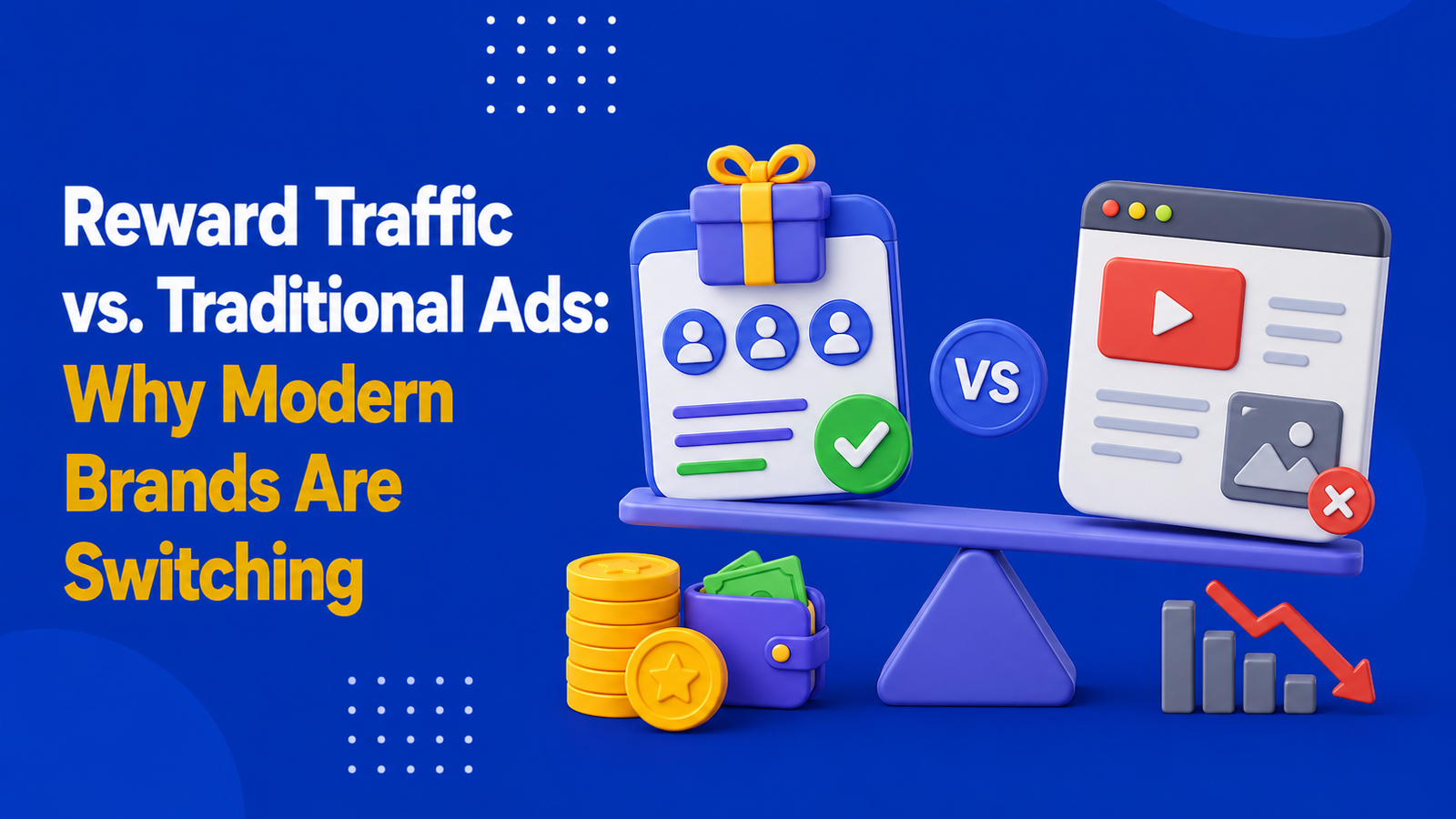
Digital advertising has changed dramatically over the past decade. Brands once focused primarily on reaching as many people as possible through display ads, social media campaigns, and search advertising. Today, that strategy is becoming increasingly expensive and less predictable. Growing competition has pushed advertising costs higher, while privacy regulations and platform changes have reduced the effectiveness of traditional audience targeting. According to Statista, global digital advertising spending continues to rise year after year, yet many advertisers are seeing diminishing returns as customer acquisition becomes more expensive. At the same time, privacy initiatives such as Apple's App Tracking Transparency have made user-level tracking more difficult, forcing brands to rethink how they attract and convert customers.
As these challenges continue to reshape the advertising landscape, many companies are shifting toward performance-driven acquisition channels where every marketing dollar is tied to measurable outcomes. Reward traffic has emerged as one of the strongest examples of this evolution, offering brands a way to acquire users through voluntary, incentivized actions rather than passive ad exposure.
1. Reward Traffic Aligns User Intent With Brand Goals
One of the biggest reasons reward traffic performs so well is that users willingly choose to participate. Instead of interrupting someone with an advertisement, reward-based platforms invite users to complete specific actions—such as installing an app, signing up for a service, or participating in a survey—in exchange for a clearly defined reward.
Because users understand both the task and the incentive before they begin, engagement tends to be far more intentional. Research from eMarketer has shown that incentivized experiences often generate stronger participation and completion rates because users have a clear reason to follow through. Rather than hoping someone clicks an ad out of curiosity, brands interact with users who have already committed to completing an action, creating value for both sides.
Brands don't simply buy attention—they reward meaningful participation, making every interaction more intentional for both advertisers and users.
2. Performance-Based Pricing Reduces Advertising Risk
Traditional advertising frequently requires brands to pay for impressions or clicks regardless of whether those interactions generate meaningful business results. Reward traffic follows a different model by tying advertising costs directly to completed actions.
Industry research from the Mobile Marketing Association highlights that performance-based models such as CPA (Cost Per Action) and CPE (Cost Per Engagement) generally produce stronger return on investment because advertisers only pay when predefined objectives are achieved. Whether the goal is an app install, account registration, purchase, or subscription, brands can measure exactly what they're paying for instead of relying on estimated engagement.
This level of predictability allows companies to allocate budgets more efficiently while reducing wasted advertising spend.
3. Rising Acquisition Costs Make Traditional Ads Less Efficient
Customer acquisition has become significantly more expensive across major advertising platforms. Increased competition for ad inventory, combined with declining targeting precision, has forced brands to spend more to reach audiences that may never convert.
According to WordStream, average CPC and CPM rates across major advertising platforms have steadily increased in recent years as advertisers compete for limited inventory. Privacy restrictions have further complicated campaign optimization by limiting access to detailed behavioral data.
Reward traffic addresses many of these challenges by focusing on users who actively choose to participate. Since users voluntarily complete offers instead of simply viewing advertisements, advertisers can often achieve stronger conversion efficiency without depending as heavily on complex tracking systems.
4. Rewarded Users Often Complete Actions More Consistently
One of reward traffic's greatest strengths is its ability to encourage immediate action. Traditional advertising often depends on creating awareness first and hoping users eventually convert. Reward-based experiences shorten this journey by giving users a clear objective and immediate motivation to complete it.
Research published by AppsFlyer suggests that rewarded acquisition campaigns frequently produce strong completion rates, particularly within offerwall environments where users actively seek earning opportunities. Combined with modern fraud prevention technologies such as behavioral analysis, device verification, and advanced attribution systems, advertisers gain greater confidence that completed actions represent legitimate user engagement rather than accidental clicks or fraudulent activity.
This combination of user intent and verification helps explain why many performance marketers continue increasing their investment in rewarded traffic.
5. Reward Traffic Fits the Future of Performance Marketing
As digital advertising continues evolving, marketers increasingly prioritize measurable outcomes over simple reach. Businesses want acquisition strategies that remain effective despite changing privacy regulations, rising advertising costs, and shifting consumer behavior.
Industry reports from Business of Apps indicate that incentivized engagement models are becoming an increasingly important part of mobile user acquisition strategies. Gamification, AI-driven optimization, improved fraud detection, and smarter onboarding experiences continue making reward traffic more efficient for both advertisers and users.
Rather than replacing traditional advertising entirely, reward traffic increasingly complements broader marketing strategies by providing a scalable, performance-focused channel where every completed action delivers measurable business value.
As digital advertising becomes more competitive and privacy-focused, reward traffic offers brands a measurable, user-friendly way to acquire customers while giving users meaningful value for their participation.
Why More Brands Are Investing in Reward Traffic
Reward traffic has evolved from a niche acquisition channel into a core component of modern performance marketing. By combining voluntary user participation, performance-based pricing, measurable outcomes, and reliable conversion quality, it addresses many of the challenges that traditional advertising faces today. As acquisition costs continue rising and brands demand greater accountability from their marketing budgets, reward traffic offers a practical balance between user experience and business performance. Instead of simply paying for visibility, advertisers invest in completed actions that generate real value—making reward traffic one of the most resilient and scalable advertising models for the years ahead.
Related Articles
Personalization vs. Privacy: Balancing the Two in Digital Advertising
Discover how digital advertisers can balance the benefits of personalized ads with the growing need for privacy, ensuring a seamless user experience while respecting data security.
CPA, CPI, or CPE? Choosing the Right Offerwall Model for Your Campaign
Confused between CPA, CPI, and CPE for your offerwall campaign? Discover how each model impacts reach, engagement, and ROI — and which one truly pays off.