Gamified Earning: Why Users Love Levels, Streaks & Badges

Ajeet Thapa
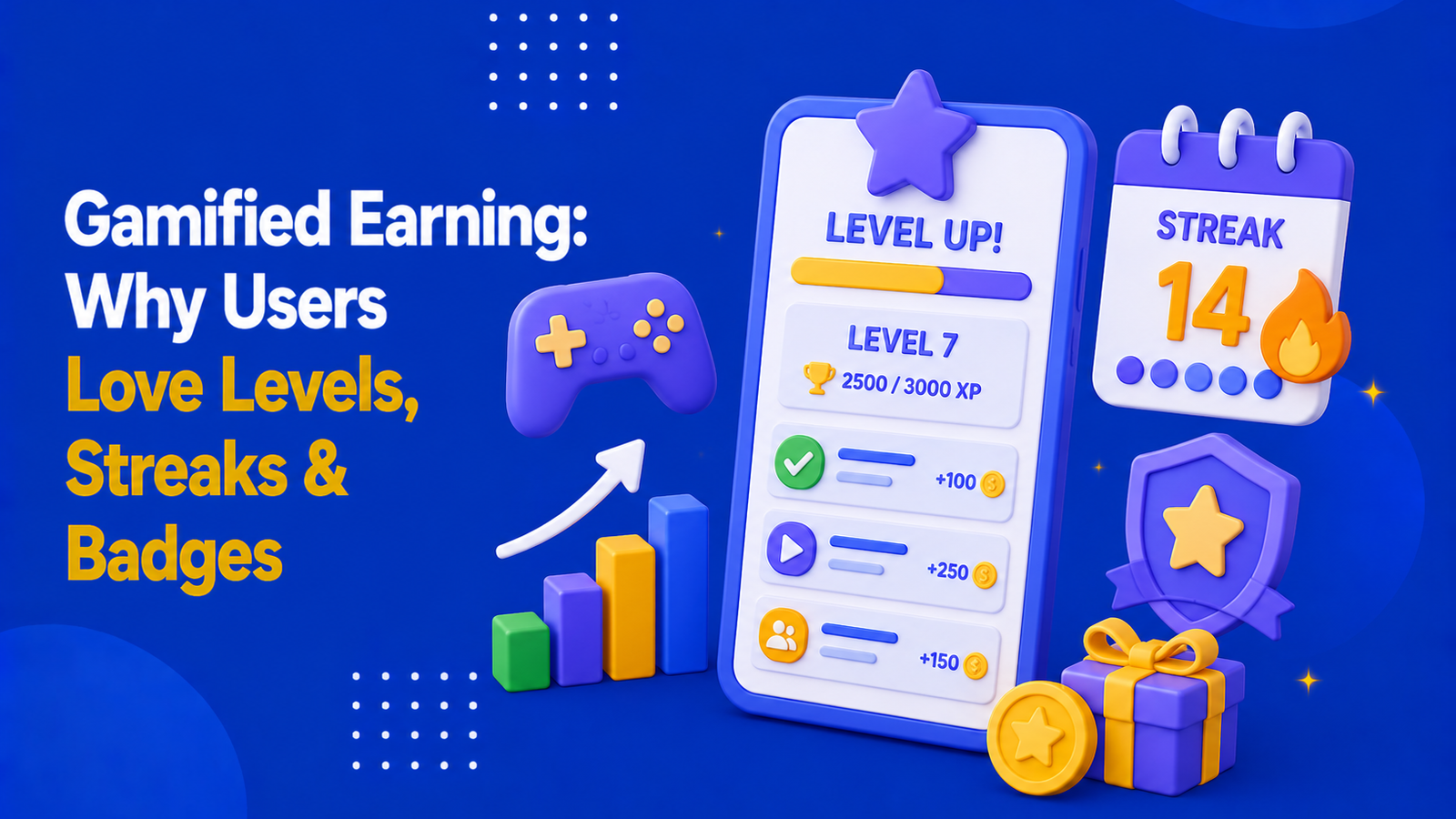
The way people interact with earning platforms has changed dramatically over the past few years. What once focused purely on completing tasks for monetary rewards has evolved into a more engaging experience where users are motivated by progress, achievement, and personal growth. Today, GPT platforms, micro-task apps, reward ecosystems, and digital earning platforms increasingly rely on gamification to transform simple activities into interactive experiences that encourage users to return consistently.
This shift is driven by a deeper understanding of user psychology. People are naturally motivated by visible progress, recognition, competition, and the satisfaction of completing challenges. By introducing elements such as levels, streaks, badges, and achievement systems, earning apps create stronger emotional connections with users while improving engagement and retention. The following sections explore how gamification influences user behavior, why these mechanics are becoming essential for earning platforms, and how the future of digital earning will become even more interactive.
1. Progress Systems Turn Simple Tasks Into Meaningful Journeys
One of the biggest reasons gamification works so effectively in earning apps is that it gives users a sense of progression. Without gamification, completing surveys, testing apps, or finishing small online tasks can feel repetitive and transactional. However, when platforms introduce levels and progress milestones, every action becomes part of a larger journey where users feel they are improving and advancing.
Levels create a psychological connection between effort and achievement. Even when individual tasks provide small rewards, users remain motivated because they can see their progress toward the next milestone. This creates a feeling similar to progressing through a game, where reaching a new level represents personal growth rather than just another completed activity.
People are not only motivated by what they earn—they are motivated by seeing themselves improve along the way.
2. Streaks Create Daily Habits and Stronger User Retention
Streak systems have become one of the most effective engagement tools across digital platforms because they encourage consistency. A streak rewards users for completing actions repeatedly over time, turning occasional activity into a daily habit. Once users build momentum, they become emotionally invested in maintaining their progress.
This behavior is strongly connected to loss aversion, where people feel the potential loss of something they already achieved more strongly than the excitement of gaining something new. Earning platforms use streaks to encourage users to return daily, complete additional tasks, and maintain regular engagement. Instead of asking users to return only when they need rewards, streaks create a reason to come back frequently.
For earning apps, this results in higher daily active users, stronger retention rates, and more consistent task completion. A user who checks a platform every day is more likely to discover new opportunities and contribute greater long-term value.
A streak does not just reward activity—it transforms activity into a habit.
3. Badges and Achievements Give Users Recognition Beyond Rewards
Badges may appear simple, but they play an important role in creating emotional motivation. When users unlock achievements for completing challenges, reaching milestones, or demonstrating consistency, they receive visible recognition for their efforts. This recognition creates a sense of accomplishment that goes beyond financial incentives.
In earning ecosystems, badges can represent different forms of achievement, such as completing a certain number of tasks, maintaining accuracy, reaching experience levels, or becoming a trusted contributor. These digital achievements help users build an identity within the platform and encourage them to continue participating.
The psychological impact of recognition is powerful because users enjoy feeling valued for their contributions. A badge acts as proof of progress, reinforcing the idea that their time and effort are creating meaningful results.
Digital achievements may not have monetary value, but they create emotional value that keeps users engaged.
4. Gamification Improves Engagement, Retention, and Platform Growth
When earning platforms combine levels, streaks, and badges into a complete experience, the relationship between users and platforms becomes much stronger. Instead of viewing the platform as a simple place to complete tasks, users begin to see it as an environment where they can achieve goals and track their progress.
This emotional connection has direct business benefits. More engaged users typically complete more tasks, spend more time on platforms, and have higher lifetime value. For advertisers and businesses using these ecosystems, improved engagement creates better campaign performance because active users are more likely to complete offers and participate in activities.
Gamification also helps platforms differentiate themselves in an increasingly competitive market. When multiple apps offer similar earning opportunities, the experience itself becomes a major factor in user preference. Platforms that make earning enjoyable are more likely to retain users compared to those that only provide transactional rewards.
The strongest earning platforms are not just rewarding users—they are creating experiences users want to return to.
5. Social Competition and Personalization Are Shaping the Next Stage of Gamified Earning
The future of gamified earning will move beyond basic points, badges, and progress bars. As technology advances, platforms are beginning to explore more personalized experiences powered by artificial intelligence and behavioral insights. Instead of giving every user the same challenges, future systems will adapt based on individual activity patterns, preferences, and skill levels.
Social features will also become increasingly important. Leaderboards, community challenges, team competitions, and collaborative goals can introduce a new layer of motivation by allowing users to compare progress and participate together. These features create a stronger sense of belonging and turn earning platforms into interactive communities rather than isolated task marketplaces.
AI-driven personalization will likely become one of the biggest developments in this space. Platforms will be able to recommend suitable tasks, adjust challenge difficulty, and create customized reward paths that keep users engaged for longer periods.
The future of earning will not only be about completing tasks—it will be about creating personalized digital experiences around achievement.
6. Gamification Is Becoming the Foundation of Digital Earning Experiences
Gamification has evolved from a simple engagement technique into a core strategy for modern earning platforms. By combining psychological principles with digital experiences, platforms can transform ordinary tasks into motivating challenges that encourage users to participate consistently.
As competition increases across GPT platforms, micro-task apps, and reward ecosystems, user experience will become just as important as the rewards themselves. Platforms that understand motivation, recognize progress, and create meaningful interactions will have a stronger advantage in attracting and retaining users.
The future of digital earning will not be defined only by how much users can earn—it will also depend on how enjoyable, rewarding, and engaging the journey becomes. Gamification provides the bridge between simple online tasks and long-term user loyalty, making it one of the most important forces shaping the next generation of earning apps.
When earning feels like progress, users do not just participate—they stay, engage, and grow with the platform.
Related Articles
The “Almost There” Effect: Why Near-Complete Offers Can Drive More Engagement
Near-complete offers can create a stronger motivation to finish. Discover how visible progress, milestones, and perceived effort influence offerwall engagement.
Why Users Are Starting to Ignore “Limited-Time” Rewards
Limited-time rewards are losing impact as users become more selective. Discover why urgency alone no longer drives engagement.
Why Users Are Becoming More Selective About Digital Rewards
Users are becoming more intentional about which rewards deserve their attention. Explore what is changing reward expectations.