Behavioral Nudges: Leveraging Cognitive Science to Boost Offerwall Conversions

Ajeet Thapa
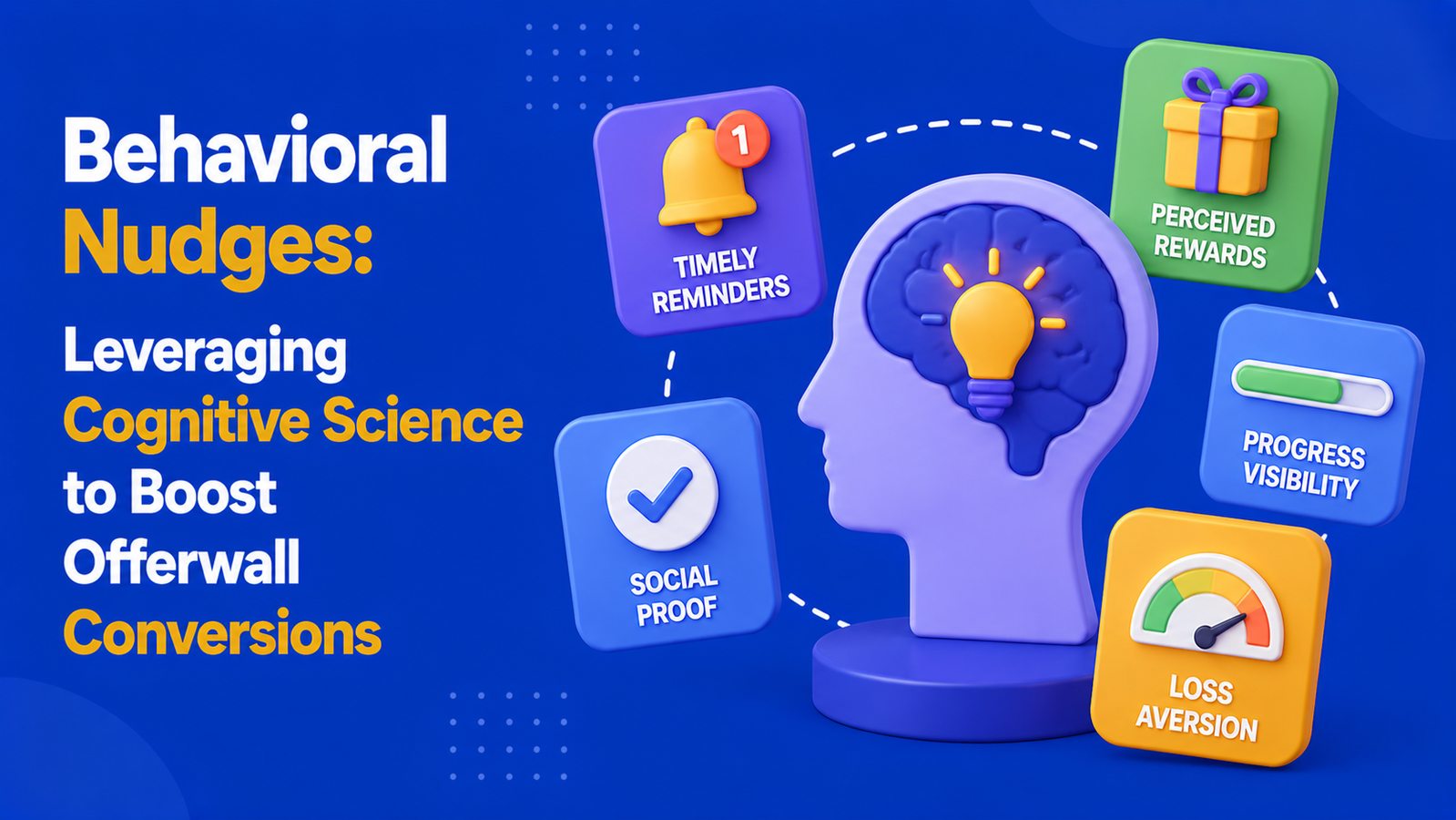
In the increasingly competitive world of app monetization, publishers can no longer rely only on reward size or offer volume to drive conversions. Users today are exposed to countless digital prompts, ads, and task-based incentives, which means attention is limited and decision-making is often fast, emotional, and heavily influenced by presentation. This is where behavioral nudges become especially powerful. Rooted in cognitive science and behavioral economics, nudges are subtle design and messaging techniques that influence user choices without forcing action. In the context of offerwalls, these nudges can help users move from passive browsing to active participation by making the experience feel clearer, more rewarding, and more psychologically compelling.
Rather than changing the core offer itself, behavioral nudges change how that offer is perceived. A task that looks confusing or low-priority can become appealing simply through better framing, urgency cues, visible progress, or contextual encouragement. When implemented strategically, nudges reduce user hesitation, guide decision-making, and improve conversion flow across the offerwall journey. For publishers and advertisers, this means higher completion rates, stronger engagement, and more value from the same user traffic. For users, it creates an experience that feels smoother, more intuitive, and more satisfying.
Understanding Behavioral Nudges in Digital Contexts

Behavioral nudges are small interventions that shape user behavior by aligning with the way people naturally make decisions. Human beings do not always make choices through careful logical analysis. In many digital environments, decisions are driven by emotion, convenience, habit, timing, visual emphasis, and perceived reward. Offerwalls are especially sensitive to these factors because users are often deciding within seconds whether a task is worth their time. If the offerwall feels too cluttered, too demanding, or too unclear, users may ignore even valuable offers. Nudges help solve this by guiding attention toward specific actions and making those actions feel easier and more worthwhile.
In a digital offerwall environment, nudges can take many forms. A highlighted reward card, a progress bar, a “recommended for you” label, or a limited-time reward banner can all influence how users interpret the value of an offer. These small cues reduce cognitive friction by helping users decide faster. Instead of asking the user to analyze every offer equally, the interface gently directs attention to the most relevant or easiest next step. This is important because too much choice often creates paralysis. When users face many similar options with little guidance, they may delay action or leave entirely. Nudges organize attention and make the offerwall feel more navigable.
Cognitive science also shows that people respond more strongly when an action feels timely, socially validated, and easy to complete. This means that nudges are not random decorations; they are tools that work because they match predictable patterns in human behavior. A well-designed offerwall does not just display tasks. It actively guides the user’s mind through the decision process, helping them move from curiosity to commitment with minimal resistance.
Framing and Reward Presentation

The way an offer is framed can have a dramatic impact on conversion performance. Two offers with the same actual value may perform very differently depending on how the reward, effort, and timing are presented. Framing affects how the brain interprets the opportunity. For example, when users see a reward described in a direct and benefit-focused way, they are more likely to view it as valuable. “Earn rewards in minutes” feels more motivating than a generic instruction such as “Complete this action.” Even when the underlying task is the same, the emotional response changes based on the wording and visual structure.
In offerwalls, framing can also reduce perceived effort. A task that seems long or complicated may become more approachable when broken into visible stages or paired with reassuring cues such as estimated completion time, quick-start messaging, or beginner-friendly labels. Users are much more likely to begin an action when the first step feels simple. Once they begin, momentum often carries them further. This is why effective framing is not only about making offers look attractive, but also about making them feel manageable. Reducing uncertainty is a major conversion advantage.
Reward presentation is equally important. Visual emphasis, color hierarchy, spacing, icons, and placement all shape how users rank offers in their minds. If the most valuable or highest-converting offers are not visually distinct, users may overlook them. On the other hand, when reward amounts are clearly visible, paired with positive visual cues, and presented as achievable milestones, users are more likely to engage. Progress-based framing is especially effective because people feel motivated when they can see advancement. A user who sees that they are “one step away” from a reward often feels more compelled to continue than a user who sees only the total task requirement.
Framing can also activate emotional triggers like immediacy and anticipation. Users respond strongly when they feel the reward is close, tangible, and relevant to them. This is why messaging around instant rewards, bonus unlocks, or milestone achievements often performs well. The goal is to shift the mental experience from “This is another offer” to “This is a rewarding opportunity I can achieve right now.”
Leveraging Social Proof and Scarcity

Social proof is one of the most effective behavioral tools in digital interfaces because people instinctively look to others when making decisions, especially in uncertain situations. In an offerwall, users often wonder whether a task is legitimate, whether it is worth the time, or whether others are actually completing it. Social proof answers those questions indirectly by showing that other users are participating. When users see signs that an offer is popular or frequently completed, their confidence increases. The offer feels safer, more trusted, and more valuable.
This can be reflected through subtle interface cues such as showing how many users completed an offer recently, marking an offer as trending, or identifying tasks as popular among similar users. These signals reduce hesitation because they replace uncertainty with familiarity. A user is more likely to engage with something that appears already validated by others. In psychological terms, this works because people use social behavior as a shortcut for decision-making. Rather than analyzing all details themselves, they rely on group behavior as evidence of value.
Scarcity works in a slightly different but equally powerful way. When something appears limited, users perceive it as more valuable and become more motivated to act quickly. In offerwalls, scarcity can be expressed through time-sensitive bonuses, limited reward multipliers, or exclusive opportunities available for a short window. This creates urgency and reduces the chance that users postpone the decision. Many conversions are lost not because users reject the offer, but because they delay action and then forget or disengage. Scarcity nudges help close that gap by giving users a reason to act now rather than later.
However, both social proof and scarcity must be used carefully. If users feel that popularity signals are exaggerated or urgency is artificial, trust can drop quickly. Offerwall environments depend heavily on credibility. That means these nudges should feel authentic, proportionate, and integrated naturally into the user experience. When done well, they create a stronger psychological pull without making the interface feel manipulative. The result is an environment where users feel both confident and motivated, which is one of the strongest combinations for improving conversions.
Benefits for Publishers and Advertisers

The use of behavioral nudges creates measurable benefits for every side of the offerwall ecosystem. For publishers, the most immediate advantage is improved conversion efficiency. Instead of relying solely on larger rewards or more aggressive monetization mechanics, publishers can increase performance by helping users make better decisions more quickly. Small improvements in click-through rate, task initiation, and completion behavior can significantly raise revenue over time, especially when multiplied across a large user base. Nudges also help reduce abandonment by keeping users engaged at key moments where they might otherwise hesitate or drop off.
Another major benefit is improved user experience. Offerwalls often fail not because the offers are weak, but because the experience feels confusing, generic, or mentally exhausting. Behavioral nudges simplify the journey. They make the interface feel smarter and more responsive, which can improve satisfaction even before the user earns a reward. A user who feels guided is more likely to trust the platform, explore more offers, and return in the future. This contributes to higher retention and stronger long-term monetization rather than one-time interaction spikes.
For advertisers, behavioral nudges can improve the quality of conversions. When users are guided toward offers that match their interests, readiness, or usage patterns, the result is often more meaningful engagement. Instead of attracting low-intent users who click impulsively and abandon quickly, advertisers benefit from users who feel aligned with the offer and are more likely to complete deeper funnel actions. This improves campaign efficiency and increases the value of offerwall traffic as a performance channel.
Behavioral nudges also generate useful behavioral data. Publishers can observe which visual cues, framing styles, or urgency messages produce the strongest results for different user segments. Over time, this creates a feedback loop where the offerwall becomes increasingly optimized. Rather than designing based on guesswork, teams can refine the experience using real behavioral patterns. In that sense, nudges are not only a conversion tactic but also a source of strategic insight.
Challenges and Ethical Considerations

Although behavioral nudges can be highly effective, they must be used responsibly. The line between guidance and manipulation can become blurry if the design prioritizes short-term conversions over user trust. Ethical implementation is essential because offerwalls rely on a fair value exchange. Users are willing to engage when they feel informed, respected, and properly rewarded. If nudges distort expectations, hide effort, or exaggerate benefits, the short-term gain may lead to long-term damage in trust, retention, and brand reputation.
Transparency is one of the most important ethical principles. Users should clearly understand what action is required, what reward they will receive, and what conditions apply. Nudges should support decision-making, not obscure reality. For instance, urgency messaging should reflect actual deadlines, and social proof indicators should be genuine rather than inflated. When users discover that a prompt was misleading, the emotional reaction can be much stronger than if no nudge had been used at all. Trust, once broken, is difficult to rebuild.
There is also the issue of over-optimization. An offerwall filled with too many badges, highlights, urgency banners, and recommendation labels can become visually noisy and psychologically overwhelming. Instead of helping the user, it creates pressure and confusion. Good nudging is subtle. It respects the user’s attention and uses just enough influence to guide behavior without dominating the experience. Publishers need to test carefully and find the balance between persuasive design and interface clarity.
Another consideration is segment fairness. Different users respond differently to behavioral cues, and what works for one group may create friction for another. This makes testing and iteration important, but it also raises the need for inclusive design. Nudges should enhance accessibility and usability rather than making the experience harder for users who are less familiar with digital task systems. Ethical behavioral design is ultimately about making the platform better for users while also improving business outcomes.
Looking Ahead: The Future of Cognitive Science in Offerwalls
The future of offerwall optimization will likely become much more behavior-driven, adaptive, and personalized. As platforms collect more data on how users respond to different types of offers, layouts, and prompts, nudges will become more precise and context-aware. Instead of showing the same interface to every user, future offerwalls may dynamically adjust framing, urgency, sequencing, and recommendations based on each person’s activity patterns, interests, and completion history. This will allow platforms to present the right nudge at the right moment, increasing effectiveness without relying on aggressive tactics.
Artificial intelligence and machine learning will likely play a major role in this evolution. These systems can identify behavioral patterns at scale and optimize which nudges work best for different user segments. A new user might benefit from trust-building and simplicity cues, while a returning high-engagement user might respond better to milestone challenges or exclusive reward framing. This kind of behavioral personalization turns cognitive science into a real-time growth engine rather than a static design principle.
At the same time, the most successful platforms will be the ones that combine performance with trust. As users become more aware of digital persuasion techniques, authenticity and transparency will matter even more. The future is not about pushing users harder. It is about understanding how people think, reducing friction, and building reward experiences that feel genuinely helpful and motivating. In that environment, behavioral nudges will become one of the most powerful tools for turning offerwalls into intelligent, user-centered monetization systems.
Related Articles
Gamified Earning: Why Users Love Levels, Streaks & Badges
Earning apps use levels, streaks, and badges to spark motivation and boost retention. See why these gamified features keep users engaged daily.
Voice & AR-Enabled Offerwalls: Using Augmented Reality and Voice Commands for Immersive Rewards
Unlock next-level engagement with offerwalls that use AR and voice commands. Turn every reward into an immersive experience users can’t resist interacting with.

The Psychology of “Invisible Rewards”: Leveraging Non-Monetary Incentives for Retention
Harness the power of invisible rewards to boost retention. Non-monetary incentives like badges and recognition motivate users to engage consistently over time.