Integrating Social Challenges into Offerwalls for Viral Growth

Ajeet Thapa
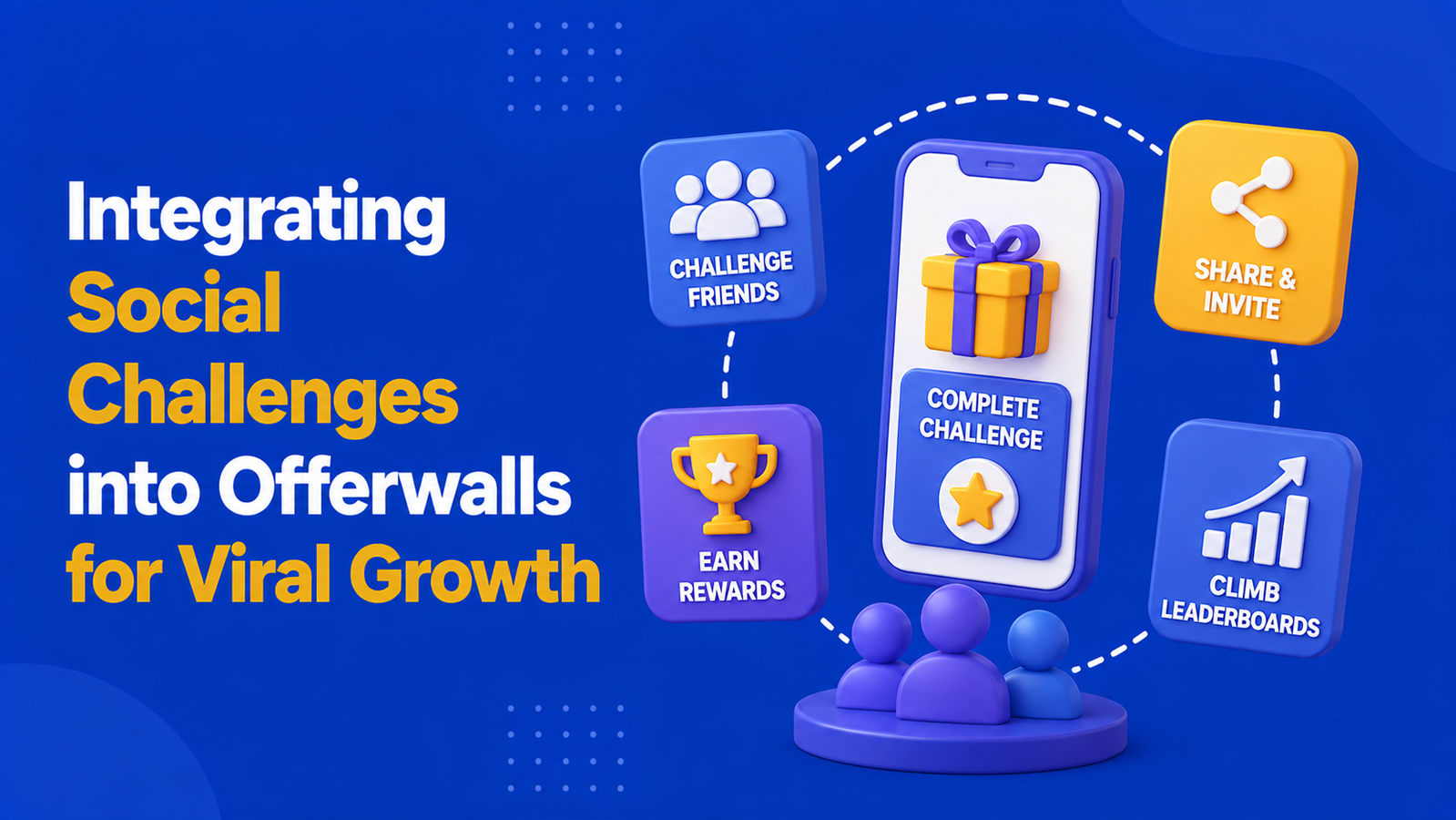
Offerwalls have long been a reliable monetization tool for apps, rewarding users for completing tasks such as installs, surveys, sign-ups, or in-app actions. However, as competition for user attention grows and acquisition costs continue to rise, traditional offerwall models are being pushed to evolve. Users no longer respond as strongly to static lists of offers alone. They increasingly expect interactive, rewarding, and socially engaging experiences. This is where social challenges come in. By integrating social mechanics into offerwalls, publishers can turn individual task completion into a shared and highly engaging experience that encourages participation, repeat engagement, and organic user acquisition.
Social challenges add a new layer of motivation by allowing users to participate in reward-based activities that involve friends, groups, competitions, referrals, or collaborative milestones. Instead of a user completing an offer in isolation, they become part of a broader challenge ecosystem where their actions contribute to visible progress, rankings, or group rewards. This changes the emotional dynamic of the offerwall. It becomes not just a monetization surface, but a social experience that taps into competition, cooperation, recognition, and community. For publishers and advertisers, this creates a powerful opportunity to increase conversions while also generating viral growth through natural sharing and peer influence.
The Evolution of Offerwalls Beyond Individual Tasks

Traditional offerwalls are built around a simple value exchange. A user completes a task, and in return, they receive a reward. While this model is effective, it often treats the user journey as purely individual and transactional. That limits how emotionally engaging the experience can become. Once a task is completed and a reward is received, the interaction often ends. Social challenges change this by extending the offerwall experience beyond a single action and connecting it to broader user behavior and peer participation.
When users are given the chance to join a challenge, invite friends, compete for a higher tier, or unlock a group reward, the offerwall becomes more dynamic. Completion is no longer just about earning points or currency. It is also about status, momentum, and participation in something larger than the task itself. This creates stronger motivation because users are influenced not only by the reward, but by the visibility of progress and the social context around it. In many digital environments, people are more engaged when their actions feel connected to others. Integrating social challenges into offerwalls builds on that behavior by transforming isolated actions into socially reinforced interactions.
This evolution is especially relevant in mobile apps, gaming ecosystems, and digital communities where users are already accustomed to challenges, badges, rankings, and social sharing. Offerwalls that adopt these mechanics can feel more native to the user experience rather than separate from it. That alignment helps reduce friction and encourages users to engage more frequently and with greater enthusiasm.
How Social Challenges Drive User Motivation

Social challenges are effective because they tap into several core psychological drivers at once. People are naturally motivated by recognition, competition, collaboration, and the desire to belong. When these motivations are combined with reward-based monetization, the result can be significantly stronger engagement than what a standard offerwall delivers on its own. A social challenge gives users a reason not just to complete an offer, but to care about how and when they complete it.
For example, a user may be more likely to finish an offer if doing so helps their team reach a milestone, improves their position on a leaderboard, or unlocks a bonus for a friend group. This social layer increases emotional investment. The action feels less routine and more meaningful. Even small social elements, such as seeing friends join a challenge or receiving recognition for completing a milestone, can create a stronger sense of momentum. Users begin to associate the offerwall not only with rewards, but with progress, achievement, and participation in a shared activity.
Social challenges also make repetition more appealing. A user who might ignore a second or third offer in a static environment may re-engage if those offers contribute to an ongoing challenge or weekly event. This is critical for retention. Instead of relying on one-time conversions, publishers can use social challenge structures to encourage ongoing activity and habitual interaction. Over time, this can significantly raise user lifetime value while also improving advertiser outcomes through more consistent and higher-quality participation.
Viral Growth Through Sharing and Peer Influence

One of the most valuable effects of integrating social challenges into offerwalls is the potential for viral growth. In traditional monetization flows, publishers often need to spend heavily on paid acquisition to bring in new users. Social challenges create a more organic path by giving users reasons to invite others, share progress, and promote participation within their own networks. When the reward structure includes collaborative goals, referral-based bonuses, or shared milestones, users themselves become part of the growth engine.
This works because people trust people. A recommendation or invitation from a friend is often more persuasive than a direct ad. If a user is already engaged in an offerwall challenge and sees value in it, they are more likely to encourage others to join. This can be amplified when the app makes sharing feel seamless and rewarding. A challenge that becomes more valuable when friends participate creates a natural incentive loop. Users do not just share content randomly; they share because doing so improves their own experience while bringing others into the same rewarding system.
Peer influence also increases conversion confidence. If a user sees that others are participating in a challenge, completing offers, and earning rewards, the experience feels more legitimate and appealing. Social visibility reduces uncertainty, which is often a major barrier in offerwall engagement. A task that seems uninteresting or risky on its own may feel worth attempting if others are visibly participating. This effect can help publishers not only grow faster, but also improve the performance of existing offers by increasing trust and perceived value through social proof.
Designing Social Challenge Systems That Actually Work

The success of social challenges depends heavily on design. Simply adding a referral button or a leaderboard is not enough. The system needs to feel meaningful, easy to understand, and aligned with user behavior. The best social challenge systems are those that make participation feel rewarding from the start while gradually introducing deeper levels of engagement. This usually means balancing simplicity with progression. Users should be able to understand the challenge quickly, see how their actions matter, and recognize what they stand to gain.
Clarity is essential. Users need to know what the challenge is, how long it lasts, what actions count, and what rewards are available. If the challenge feels confusing or overly complex, engagement will drop. Visibility is equally important. Progress bars, milestone counters, friend activity indicators, and challenge completion status all help make the system feel active and alive. These visual cues reinforce motivation and create a sense of forward movement that keeps users returning.
The reward structure must also be well balanced. If the social challenge feels too difficult, users may disengage early. If it feels too easy or low value, it may not generate excitement. Publishers need to design challenge systems that offer immediate participation rewards while also reserving larger incentives for continued involvement. This layered approach keeps users interested over time. In addition, the experience should feel fair. Challenges that favor only the most active or highest-spending users can discourage broader participation. A good system should allow both casual and highly engaged users to feel they have a meaningful chance to succeed.
Benefits for Publishers and Advertisers

For publishers, social challenges create multiple layers of value beyond direct offer completion. First, they can increase engagement by making the offerwall feel less like a utility and more like an event-driven experience. This improves session length, repeat visits, and overall interaction depth. Second, social challenges can increase retention because users return not only for rewards, but to maintain progress, stay competitive, or support group goals. Third, they can generate organic growth by encouraging users to bring in friends and expand participation through sharing.
Advertisers also benefit because socially engaged users tend to be more motivated and more likely to complete higher-value actions. A user who participates in a challenge with visible goals or social accountability may show stronger intent than a user who clicks an offer casually. This can improve conversion quality and downstream campaign performance. In many cases, social challenge participants are not just completing offers once; they are participating repeatedly, exploring more deeply, and becoming more invested in the ecosystem. That makes them more valuable over time.
Another major advantage is data. Social challenge systems reveal how users behave not only individually, but in response to peer activity, challenge design, and group incentives. This gives publishers more insight into what drives motivation, which users are most influential, and which types of challenges create the strongest results. These insights can be used to optimize not only offerwall performance, but also broader engagement and monetization strategies across the app.
Challenges and Strategic Considerations
While social challenges offer strong upside, they also require careful planning. One challenge is avoiding superficial gamification. If the social layer feels forced or disconnected from the core user experience, users may ignore it. The challenge must feel relevant to the app’s audience and natural within the product environment. For example, a gaming app may benefit from competitive challenges and team rewards, while a utility app may perform better with collaborative milestones or referral achievements.
Another consideration is moderation and fairness. Social systems can create unhealthy competition or spam-like sharing behavior if not managed well. Publishers need to ensure that sharing mechanisms are user-friendly and respectful, not intrusive. Rewards should encourage genuine engagement rather than low-quality referrals or repetitive behavior. It is also important to protect user trust. If a challenge appears misleading, too difficult to complete, or unfairly weighted, the negative impact can be greater than with a standard offerwall because social disappointment spreads quickly.
Technical integration also matters. Social challenges require real-time tracking, reward synchronization, and accurate progress visibility. If users complete actions but do not see progress update correctly, trust in the system can drop fast. That means infrastructure, analytics, and reward logic must be reliable. The more social a system becomes, the more important consistency and transparency become. Users need to believe that the challenge is fair, active, and worth their time.
Looking Ahead: The Future of Socially Driven Offerwalls
The future of offerwalls is likely to be far more interactive, community-based, and behaviorally intelligent than the traditional models of the past. Social challenges represent an important step in that direction. As user expectations continue to shift toward experiences that feel more personalized, participatory, and rewarding, offerwalls that remain purely static may struggle to maintain attention and performance. Social mechanics help solve that by turning monetization into something users can actively engage with rather than passively browse.
As AI, personalization, and real-time analytics continue to improve, social challenges will likely become even more adaptive. Publishers may soon be able to create personalized challenge pathways, group users by behavior type, and dynamically adjust reward structures based on participation patterns. This would allow offerwalls to become more than conversion tools. They would become living engagement systems that respond to user behavior and amplify growth through community interaction.
For publishers and advertisers seeking stronger retention, more organic user acquisition, and deeper engagement, integrating social challenges into offerwalls offers a compelling opportunity. It combines the proven value of reward-based monetization with the emotional power of community, recognition, and shared progress. When executed thoughtfully, it can transform the offerwall from a transactional surface into a viral growth engine that keeps users engaged and brings new users in naturally.
Related Articles
Tapjoy vs AdGem: Comparing Two Mobile Offerwall Platforms
Learn how Tapjoy and AdGem compare across offerwall integration, campaign relevance, tracking, reporting, and monetization strategy to help mobile publishers evaluate their options.

Why High-Value Offers Can Underperform: The Psychology Behind Bigger Rewards
Discover why bigger rewards do not always drive conversions and how effort, trust, complexity, and perceived value influence offerwall performance.
The Emerging Economics of Time-Based Digital Rewards
Time is becoming an important part of reward value. Explore how effort, speed, and time-to-reward are changing digital reward economics and user engagement.